Follow Us –


Why Your Garage Needs a Different Kind of Fire Detection
Aug 21, 2026
Think about everything you keep in your garage.
Vehicles. Power tools. Lawn equipment. Batteries and chargers. Paint. Gasoline. Propane. Cardboard boxes and everything else that doesn't quite have a place inside the house.
For many homeowners, the garage contains a unique combination of potential fire hazards.
So it might seem obvious to install a smoke alarm there.
But a traditional smoke alarm isn't necessarily the right solution for a garage.
The garage is a very different environment from the rest of your home and protecting it requires thinking differently about how a potential fire is detected.
Why Traditional Smoke Alarms and Garages Don't Always Mix
Smoke alarms play an essential role throughout the home. The U.S. Fire Administration recommends installing them inside every bedroom, outside sleeping areas and on every level of the home.
The garage, however, is different.
Vehicle exhaust, dust, fumes, insects, changing humidity and significant temperature swings can all create challenging conditions for a traditional smoke alarm. These environmental factors can contribute to nuisance alarms or interfere with normal smoke alarm operation.
That's why the U.S. Fire Administration recommends heat alarms rather than smoke alarms for garages.
Instead of looking for smoke particles in the air, a heat alarm responds when temperatures reach certain conditions.
That distinction makes heat detection particularly well suited for an environment like the garage.
Garages Present Their Own Fire Risks
The need for garage fire protection shouldn't be overlooked simply because a traditional smoke alarm may not be appropriate for the space.
In fact, the U.S. Fire Administration notes that garage fires tend to spread farther and result in more injuries and greater property loss than fires beginning in other areas of the home.
Consider some of the things commonly found in today's garage:
- Vehicles and fuel
- Gasoline and propane
- Lawn equipment
- Power tools
- Paints and solvents
- Electrical equipment
- Battery chargers
- Lithium-ion batteries
- Combustible storage materials
The garage has evolved well beyond a place to park the family car. For many homeowners, it's also a workshop, storage room, charging station and entryway into the home.
All of that makes detecting unusual heat conditions especially valuable.
Smoke Detection vs. Heat Detection
Smoke alarms and heat alarms are designed to recognize different signs of a potential fire.
A smoke alarm detects particles produced by combustion.
A heat alarm monitors temperature and responds when specified heat conditions are reached.
That means a heat alarm can operate in environments where everyday dust, exhaust or fumes could make traditional smoke detection problematic.
It's an important example of why fire protection doesn't necessarily have to look the same in every room.
Taking Heat Detection a Step Further
Not every developing fire produces the same conditions.
In addition to monitoring for high temperatures, some heat-detection technologies can identify when the temperature in a space is rising unusually quickly.
This is often referred to as rate-of-rise heat detection.
Rather than waiting only for the room to reach a predetermined high temperature, rate-of-rise detection looks for a rapid change in temperature that could indicate a developing fire.
That additional awareness can be especially valuable in a garage, where temperatures naturally fluctuate but an abnormal, rapid increase may signal something very different.
Why PLACE Garage Was Designed Differently
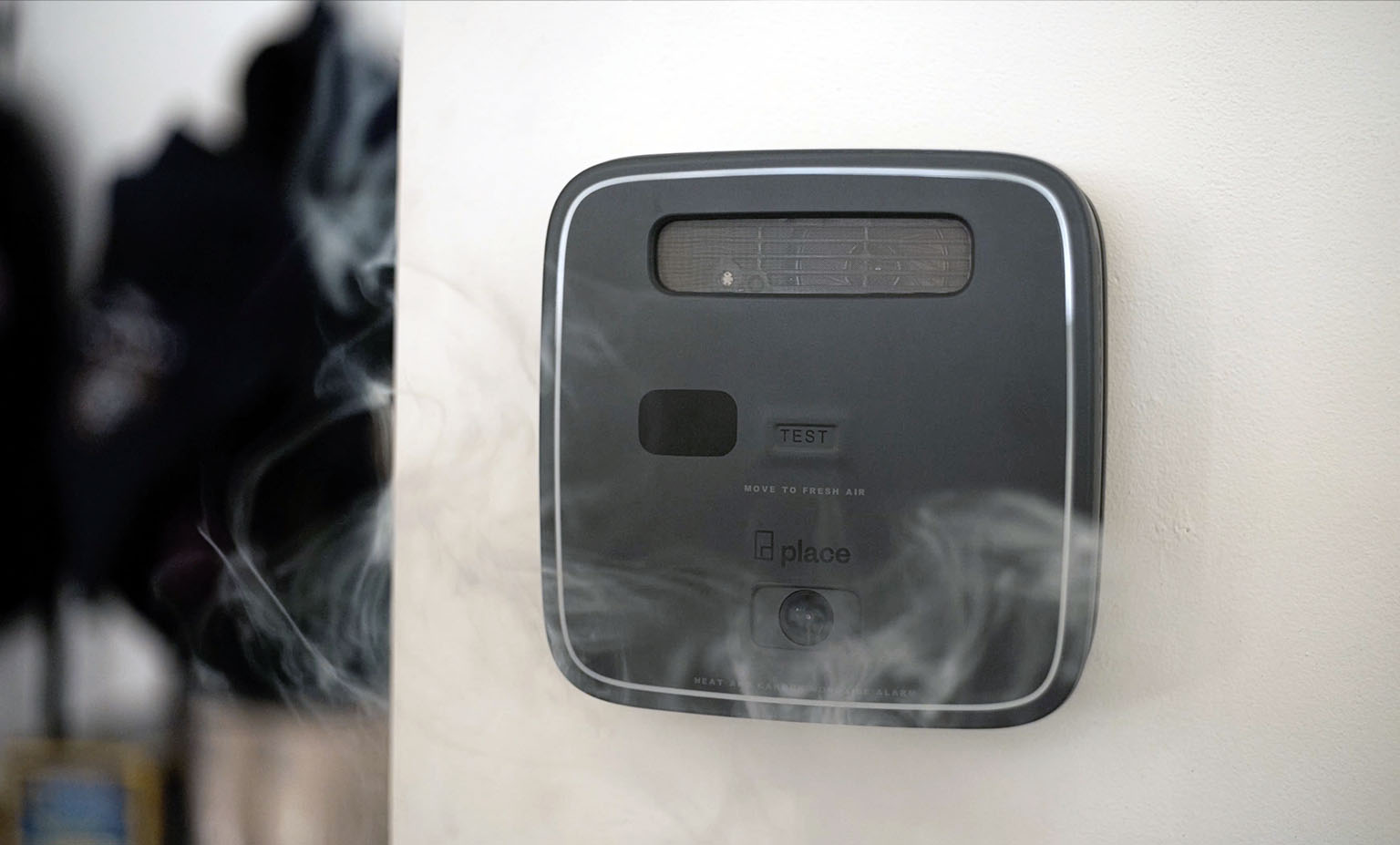
This room-specific challenge is exactly why PLACE Garage isn't simply another smoke alarm.
PLACE Garage uses heat detection, rather than traditional smoke detection to help identify potential fire conditions in the garage environment.
It also monitors for carbon monoxide, another important consideration around vehicles and fuel-burning equipment.
And because the garage is often one of the largest entry points into the home, PLACE Garage incorporates additional connected features, including a camera and two-way communication, to provide homeowners with greater awareness of what's happening in the space.
The idea isn't to add features simply for the sake of adding technology.
It's to design the device around the room where it's going to live.
Different Rooms. Different Conditions. Different Risks.
Most homes have traditionally approached fire protection in much the same way from room to room.
But think about how different those rooms actually are.
A nursery is designed around sleep, comfort and caring for a child.
A kitchen regularly produces heat, steam and cooking particles.
A garage can contain exhaust, dust, fuels, batteries, equipment and dramatic temperature changes.
The risks aren't the same, so the technology protecting those spaces doesn't always have to be the same either.
That's the philosophy behind PLACE.
By understanding what's different about each area of the home, safety technology can be designed not just for the house, but for the specific room it's protecting.
And in the garage, that starts by looking beyond smoke.
Sources
U.S. Fire Administration — *Heat Alarms*
U.S. Fire Administration — *Basement and Garage Fire Safety*
National Fire Protection Association (NFPA) — Smoke alarm installation and placement guidance
Always follow the manufacturer's installation instructions and applicable local building and fire codes when selecting and installing smoke, carbon monoxide or heat alarms.